
Tarot as a Tool for Self-Exploration
Estimated reading time: 4 minutes
Tarot is often misunderstood as something meant to predict the future. Historically, however, tarot did not begin as a divinatory practice.
The earliest known tarot decks originated in 15th century Italy, where they were commissioned as artistic playing cards for games such as Trionfi. It wasn’t until much later, particularly during the 18th century, that tarot became associated with mysticism, esotericism, and fortune telling.
Today, many people still approach tarot through the lens of prediction: What will happen? What does the future hold?
But there is another way to understand tarot—one rooted less in certainty and more in self exploration and reflection.
Psychiatrist and psychoanalyst Carl Jung viewed symbolic systems, including tarot, as meaningful tools for engaging with the unconscious mind. Jung believed that humans relate to the world through archetypes: universal symbolic patterns that shape emotion, perception, behavior, relationships, and identity. These archetypes appear across cultures, myths, dreams, and storytelling traditions. Tarot offers a structured encounter with these symbolic themes.
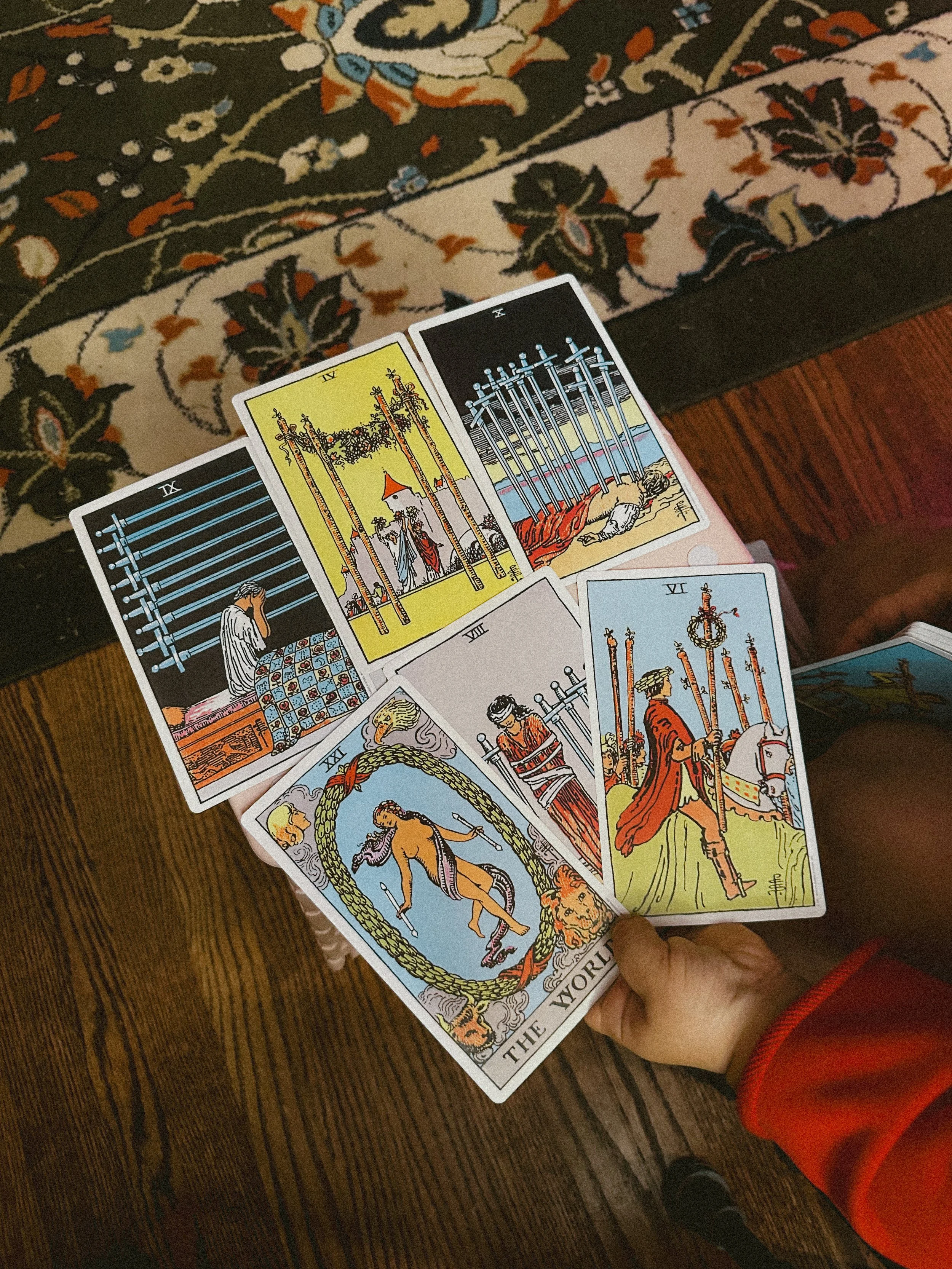
Cards such as The Fool, The Tower, Death, The Star, or The Hermit are not powerful because they “tell the future.” They are powerful because they invite reflection and interpretation. They create opportunities to explore how we make meaning of uncertainty, fear, hope, identity, relational experiences, and change.
In this way, tarot becomes less about prediction and more about perspective.
Tarot as an Experiential Tool
In psychology spaces, tools such as tarot, astrology, and numerology are often dismissed as “pseudo-science.” And to be clear: tarot is not a scientific instrument. It cannot objectively predict outcomes or provide measurable evidence in the way experimental science does.
But not everything valuable in therapy is rooted purely in objective measurement.
Therapy, itself, is deeply experiential.
We come to understand ourselves through emotion, reflection, relationship, imagination, embodiment, and meaning-making. Much of healing involves becoming aware of patterns that were previously automatic or unconscious.
Tarot can function as one reflective medium for this process—not because the cards themselves possess certainty or prediction, but because ambiguity, symbolism, and projection often reveal what is already present internally.
The same way a dream, piece of art, metaphor, or story can evoke insight, tarot can help illuminate emotional themes, internal conflicts, fears, desires, and narratives that already exist within us.
In this way, tarot is not about determining a fixed future. It is about noticing how your mind and body respond in the present moment as meaning is being made.
Sometimes uncertainty itself becomes the intervention.
Your nervous system reacts before your conscious mind fully organizes why. Certain interpretations feel immediately true, while others create resistance. Some cards evoke hope, grief, curiosity, discomfort, relief, or defensiveness. All of that information matters.
The value is not in the card itself. The value is in your relationship to it.
Tarot, Projection, and Self-Awareness
When we pull a card, we are not simply interpreting a symbol — we are also interpreting ourselves.
A card may bring up:
• fears we are avoiding
• desires we are afraid to acknowledge
• beliefs we already hold about ourselves
• unconscious expectations about the future
• attachment patterns
• shame narratives
• protective strategies
• cultural conditioning
• longing, grief, hope, or resistance
Tarot slows us down enough to notice those reactions. Instead of immediately moving into certainty or action, we pause. We reflect. We observe what meaning our mind begins constructing.
That process alone can deepen self-awareness.
Questions for Reflection After a Reading
After pulling a card, consider asking yourself:
• What was my immediate emotional reaction to this card?
• What assumptions or interpretations did my mind immediately make?
• How might those interpretations reflect my conditioning, fears, or desires?
• Am I trying to confirm something I already wish to believe?
• Is there an interpretation I am resisting or avoiding?
• What thoughts, memories, sensations, or images arose in response to this card?
• What might this reveal about my current emotional state or internal narratives?
• What would it be like to hold this situation from a different perspective?
Rather than rushing toward certainty, try staying curious.
You might also read guidebook interpretations and notice what happens in your body as you do. Pay attention to what resonates, what feels activating, what feels settling, and what feels difficult to accept.
Tarot is not a replacement for discernment, critical thinking, or therapeutic work. It is also not a substitute for clinical insight or grounded decision-making.
But it can be a creative and reflective tool for slowing down, increasing self-awareness, and exploring the stories, emotions, and patterns that shape how we move through the world.